What Do the Symbols on a Pokémon Card Mean? Every Printed Mark, and Where to Find It
A Pokémon card carries about a dozen separate marks, and each one answers a different question about the card.
Names and positions quoted from the official rulebook. Counts taken on 3 August 2026.
What do the symbols on a Pokémon card mean?
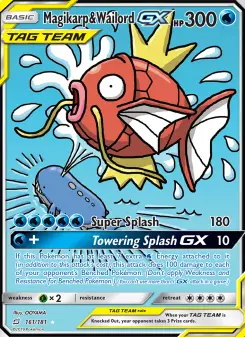
They are not decoration — each mark is a value the game reads. The coloured circles are Energy types, and the game has 11 of them. The symbols beside an attack are its cost. The marks in the lower left are Weakness and Resistance, and the ones in the lower right are the retreat cost.
Along the bottom edge sit the identity marks: the expansion code, the collector card number, a small letter that decides tournament legality, and the rarity symbol. Reading those four together identifies any of the 20,444 English cards we hold exactly.
Part names and positions quoted from the official Pokémon Trading Card Game rulebook and Play! Pokémon guidance; card counts taken on 3 August 2026.
Every mark on a Pokémon card at a glance
- Energy types11The symbol that decides what an attack costs.
- Cards with a weakness16,780And it is not always a simple doubling.
- Free-retreat Pokémon914A blank space is a value, not an omission.
- Expansions on file174The mark that says where a card came from.
- Cards with a letter8,194The regulation mark only exists from 2020 on.
- Cards with an Ability4,076A label that changes how the card is played.
Pokémon card symbols in short
- Position carries meaning. The same circle means different things depending on where it is printed — beside an attack it is a cost, in the lower left it is a weakness, in the lower right it is a retreat cost.
- Count the symbols, do not just recognise them. Two circles beside an attack means two Energy. Three in the retreat row means three Energy to swap out.
- 11 Energy types exist, and they are far from evenly used — the largest has 2,442 cards, the smallest 237.
- A missing symbol is information. 914 Pokémon print no retreat symbol at all, which means they retreat for free.
- Weakness is not always double. Most cards say ×2, but 1,118 say “add a fixed amount” instead.
- The bottom edge is the card’s identity. Expansion code, card number, regulation mark and rarity together name exactly one card out of 20,444.
- One mark decides legality and one decides scarcity, and they are not the same mark. The letter settles where you may play the card; the star settles how it was distributed.
The parts of a Pokémon card, and what each one settles
The parts the rulebook names
Two corners the rulebook calls out by name
| Mark | Where it sits | What it settles |
|---|---|---|
| Card name | Top of the card | Which card it is, and the name the four-copy limit counts |
| HP | Top right | How much damage the Pokémon takes before it is Knocked Out |
| Pokémon type | Top right, beside the HP | Which Energy the Pokémon belongs to, and what it is weak against |
| Stage and Evolves from | Top left | Whether it can be played straight from hand or needs a card beneath it |
| Trainer type | Top left on Trainer cards | Item, Supporter, Stadium or Tool — which decides how often you may play it |
| Attack cost | Left of each attack | How many Energy of which type the attack needs |
| Weakness and Resistance | Lower left | How damage from certain types is increased or reduced |
| Retreat cost | Lower right | How many Energy you discard to swap the Pokémon out |
| Collector card number | Bottom edge | The card’s number and the official size of its expansion |
| Expansion code | Bottom edge | A short code naming the expansion the card was printed in |
| Regulation mark | Bottom corner, small letter | Whether the card is legal in the current Standard format |
| Rarity symbol | Beside the card number | How the card was slotted into booster packs |
Positions follow the official rulebook diagram and the wording it uses for the lower-left and lower-right corners. Card layouts have been redrawn several times, so on an older card a mark may sit slightly differently while meaning the same thing.
Read the card in three passes
Top for identity and durability — name, stage, HP and type. Middle for what it does — attacks, their costs and any Ability. Bottom for everything about the card as an object — expansion, number, legality and rarity.
Almost every question a collector asks lives in the bottom band, and almost every question a player asks lives in the middle. Knowing which band you are in saves reading the other two.
If your question is whether the card can go in a deck at all, that is settled entirely in the bottom band — by the small letter, not by anything above it.
The Energy symbols, and how uneven they really are
The official letter key for the symbols
Matching symbols to Energy cards
| Energy type | Letter | Pokémon of this type | Share | What the rulebook says it does |
|---|---|---|---|---|
| Grass | G | 13.8% | Grass-type Pokémon often have attacks that heal themselves or make their opponents Poisoned. | |
| Fire | R | 9.1% | Fire-type Pokémon have big attacks! They can make their opponents Burned, but their attacks need time to build up again. | |
| Water | W | 14.1% | Water-type Pokémon can manipulate Energy and move Pokémon around on the other team. | |
| Fighting | F | 10.9% | Fighting-type Pokémon can take bigger risks to do extra damage, and some can flip coins for combination hits. | |
| Darkness | D | 7.4% | Darkness-type Pokémon feature sneaky attacks that often make opponents discard cards. | |
| Metal | M | 5.6% | Metal-type Pokémon can resist attacks for longer than most other Pokémon. | |
| Lightning | L | 8.8% | Lightning-type Pokémon can bring back used Energy from the discard pile, and they can make their opponents Paralyzed. | |
| Psychic | P | 13.5% | Psychic-type Pokémon are great for special powers. Their opponents often find themselves Asleep, Confused, or Poisoned. | |
| Colorless | C | 12.5% | Colorless-type Pokémon have lots of different moves, and they work with any kind of deck. | |
| Dragon | — | 3.1% | Dragon-type Pokémon have very strong attacks, but often require two Energy types to use them. | |
| Fairy | — | 1.4% | Fairy-type Pokémon have tricks that will make opposing Pokémon’s attacks less effective. |
Counted across every English card that states a type, on 3 August 2026. Dragon and Fairy have no letter in the Card-Dex key because they were introduced after those documents were written. Bar shading in each column is sized against the largest value in that column.
Fairy is the type that stopped
Fairy is the smallest type in our count at 237 cards, and the rulebook explains why rather than leaving you to guess: “Since Sword & Shield, you’ll find some Pokémon that used to be Fairy types showing up as Psychic types instead.”
So a Fairy symbol dates a card as surely as a rarity does. If you are holding one, it was printed before that change — which also makes it a useful cross-check when you are deciding whether a card is genuine.
Weakness and Resistance — the marks in the lower left
Where they sit and what they do
| Printed as | Cards | Share of cards that state a weakness |
|---|---|---|
| ×2 | 93.3% | |
| +20 | 2.9% | |
| +10 | 2.7% | |
| +30 | 1.0% | |
| +40 | 0.0% |
Counted across every English card that prints a weakness, on 3 August 2026. A “+” value adds a fixed amount of damage instead of multiplying it, so reading the sign matters as much as reading the symbol. Bar shading in each column is sized against the largest value in that column.
| Resistance to | Cards | Share of cards that state a resistance |
|---|---|---|
| Fighting | 43.9% | |
| Psychic | 18.6% | |
| Grass | 10.8% | |
| Metal | 9.9% | |
| Water | 5.4% | |
| Darkness | 4.6% | |
| Lightning | 4.3% | |
| Colorless | 2.0% | |
| Fire | 0.5% |
Counted on 3 August 2026. Resistance is far rarer than weakness — only a minority of cards print one at all. Bar shading in each column is sized against the largest value in that column.
Read the sign before you do the arithmetic

93.3% of cards that state a weakness use the multiplier form, so doubling is the safe assumption most of the time. The remaining 1,118 cards add a flat amount instead, and on a small attack that is a completely different number.
Resistance is not the mirror image of weakness. Far fewer cards print one, and one type dominates the column, which is why a deck can be built to exploit a weakness but rarely to exploit a resistance.
Retreat cost — where the number of symbols is the value
What it costs and where it is printed
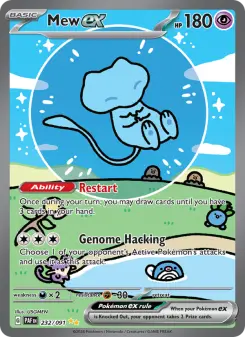
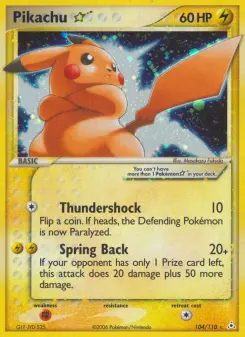
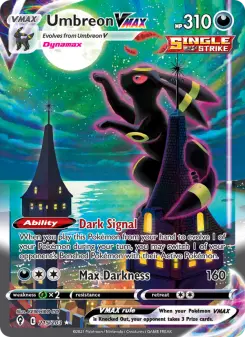
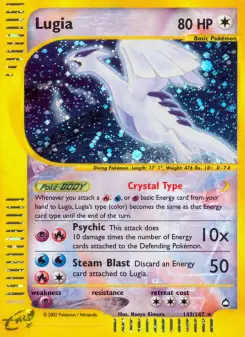
An empty corner is a value, not a printing error
914 Pokémon print nothing in the retreat corner, which means they cost nothing to swap out. New players often read that blank space as a missing detail; it is the opposite of missing.
Those cards are disproportionately useful, because a Pokémon you can move for free changes what a deck can do. That makes the retreat corner one of the first things experienced players look at when choosing what goes in a deck.
The bottom edge — expansion code, set symbol and card number
Why these marks matter more than they look
Two cards can share a name, an illustration and a rarity and still be different cards. The expansion code and number are what separate them, and they are the only marks that do.
They are also the marks that have to agree with each other. A set symbol from one expansion beside a number that belongs to another is not a variant — it is a card worth examining properly.
The regulation mark — one letter that decides where you can play
What it is and where to look
Most cards do not have one, and that is normal
8,194 of the 20,444 English cards we count carry a regulation mark — 40.1%. The other 12,250 were printed before the system existed.
Because it is the one mark that changes meaning with the calendar, it needs its own reference rather than a line here. Which letters count today, and what the yearly rotation does to them, is set out in full separately.
The rarity symbol — what the shape and the star count mean
The three basic shapes
Newer rarities count stars instead
Read the finish as well as the shape
Two black stars and two foil stars are different rarities. Under a shop’s lighting the difference is easy to miss, and it is the single most common misreading of a modern card.
How many cards carry each of these symbols, and which rarities belong to which era, is a list long enough to stand on its own page.
Words printed on the card that change how it is played
| What is printed | Where it appears | What it changes |
|---|---|---|
| Ability, in a named box | Above the attacks | It works without attacking, and often without Energy. 4,076 cards print one. |
| Stage 1 or Stage 2 | Upper left | The card cannot be played from hand alone — the card it evolves from must already be in play. |
| Item, Supporter, Stadium, Tool | Upper left on Trainer cards | How often you may play it in one turn, which is the rule new players break most. |
| A rule box in small print | Bottom of the card | Extra rules that apply only to that card — for example how many Prize cards it gives up when Knocked Out. |
| A bar across the upper right | Upper right | Marks the card as an Ultra Beast, which other cards refer to by name. |
| ACE SPEC | Beside the card name | A deck may contain only one ACE SPEC card in total, whatever its name. |
The rule box is the one people skip
It is printed small, at the bottom, in a place the eye treats as legal boilerplate. On a modern card it frequently says something decisive, such as how many Prize cards the opponent takes when that Pokémon is Knocked Out.
The rulebook flags one such label explicitly, noting cards “that interact specifically with Ultra Beasts, which are labeled with a bar in the upper-right corner of the card”. A label exists because something refers to it.
Other Pokémon card guides
- Standard, Expanded and Unlimited formats2,917 Standard-legal cardsWhich of your Pokémon cards you are allowed to play, and how the yearly rotation decides it.
- How to build a Pokémon deck60 cards exactlyThe 60-card rules straight from the official rulebook, checked against the cards that are actually legal.
- Pokémon card rarity, counted38 rarities countedEvery rarity printed on an English Pokémon card, with how many cards carry it.
- How to tell a fake Pokémon card174 expansions on fileWhat the official guidance says, plus the printed details you can check against a full catalogue.
Pokémon card symbol questions people actually ask
What do the coloured circles on a Pokémon card mean?
What is the symbol in the bottom corner of a Pokémon card?
What does the weakness symbol on a Pokémon card mean?
What does the retreat cost symbol on a Pokémon card mean?
Why does my Pokémon card have no letter at the bottom?
What does the star on a Pokémon card mean?
What is the difference between the set symbol and the expansion code on a Pokémon card?
What does the box above the attacks on a Pokémon card mean?
Sources — where these symbol names and positions come from
Primary official source
First-party official sources — the body that issues the data itself, such as a government agency, a statutory register or a rights holder publishing its own records.
Industry source
Second-party sources — marketplaces, trade associations, research institutes and companies that compile data about the market.
How we count
Card counts on this page — this site keeps its own copy of the openly published English card and expansion files and counts them directly; the figures above were counted on 3 August 2026 across 174 expansions
Note: Rules quoted on this page are taken word for word from the official Pokémon Trading Card Game rulebook and the Play! Pokémon tournament handbook, and the wording of those documents is the authority. Card counts are our own: we read the openly published English card files ourselves and counted 20,444 cards across 174 expansions on 3 August 2026. A count can only describe the cards those files contain, so a very new expansion may not be included yet, and tournament legality can change on a date the rights holder announces. Before a tournament, check the card itself against the official rules rather than this page. Card layouts have been redrawn several times over the years, so a mark described here as sitting in one corner may sit slightly differently on an older printing while meaning exactly the same thing.
Last updated: 3 August 2026