Anorith 26 — what does this card actually do?
This card has 70 HP, a top attack printed at 10 damage and a Grass weakness.
Fighting · Stage 1 · Power Keepers · measured against 20,444 cards on file — card data read July 28, 2026
What does Anorith 26 do in a game?
Anorith 26 is a Fighting Pokémon card with 70 HP, printed as Stage 1.
Its strongest attack, Fury Cutter, is printed at 10 damage for 2 Energy — 5 damage per Energy card.
Because of the Grass weakness, any Grass attack printed at 35 damage or more removes it in a single turn.
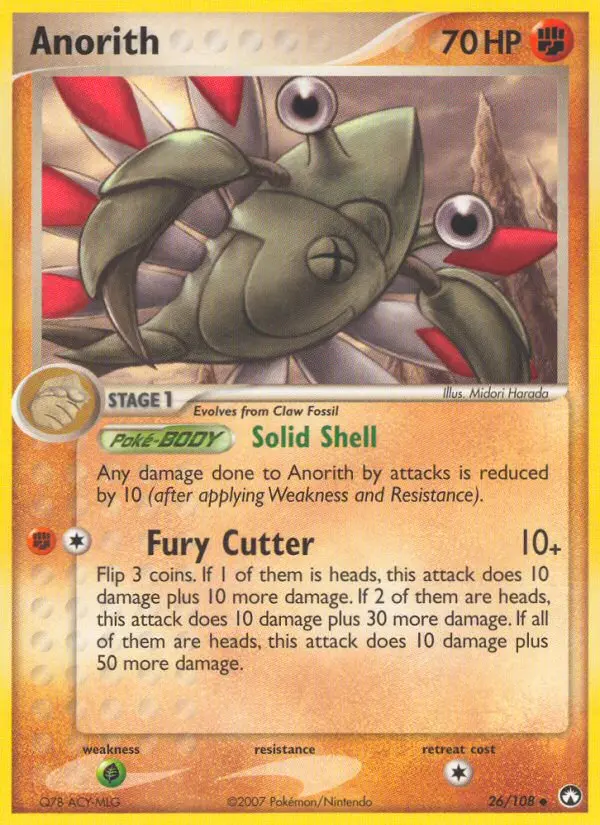
Anorith 26Power Keepers
Anorith 26 performance summary
70 HP · Fighting · Stage 1 · retreat 1 · Grass weakness ×2
as of July 28, 2026
damage per Energy card, among cards whose cheapest attack costs 2







Strongest on Retreat lightness — top 5.6% of the archive. Weakest on Top printed damage — bottom 0.1%.
Each spoke is this card's place among every card in the archive that prints that figure. Further out is stronger — retreat and attack cost are shown as lightness, so a cheap card reaches outward. Counted July 28, 2026.
| Measure | Percentile | Printed value |
|---|---|---|
| Hit points | 25.7% | 70 HP |
| Top printed damage | 0.0% | 10 damage |
| Energy efficiency | 0.3% | 5 per Energy |
| Retreat lightness | 94.4% | 1 Energy |
| Attack cost lightness | 43.8% | 2 Energy |
1 attack printed on the card. The badge is the Energy it asks for.
Among the 17,290 cards in every card in the archive that carry printed HP, this one is number 10,622 at 70 HP.
Anorith 2670 HPPrinted HP
The ceiling of this archive is 380 HP — 310 HP above this card.
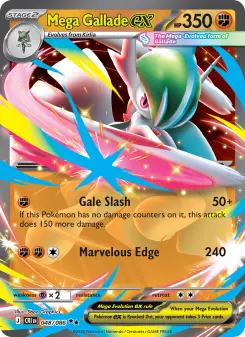
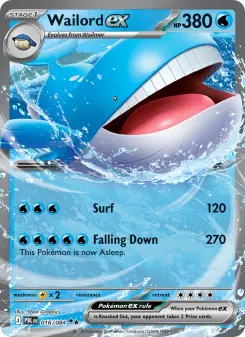
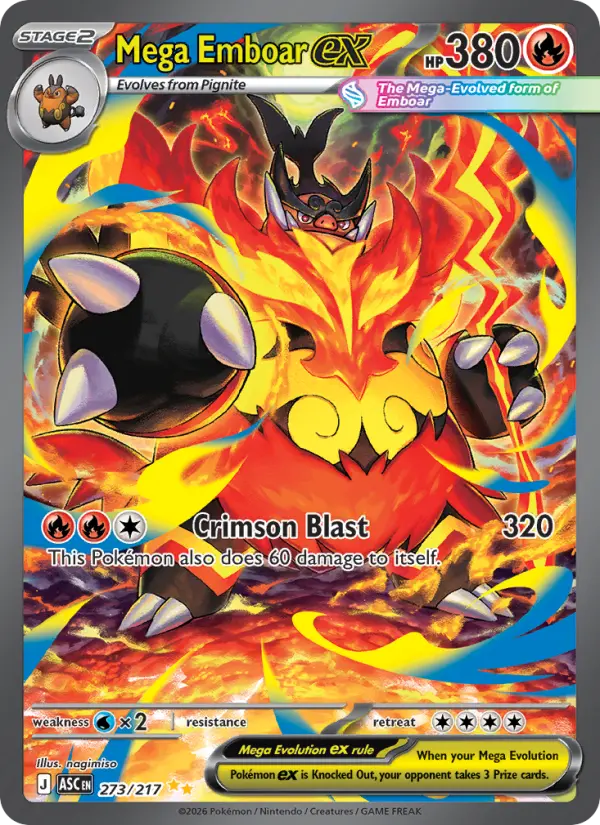 Mega Emboar ex 273380 HP
What stands out on Anorith 26
- Hit points 70 HP puts it in the ~70 band, where 38.6% of 17,290 cards with printed HP sit.
- Energy It returns 5 damage per Energy card against 32.5 for cards whose cheapest attack costs 2.
- Weakness A Grass attack printed at 35 damage or more removes it in a single turn.
- Legality 1 of the 9 prints that carry this name are legal in Standard play.
Anorith 26 at a glance
- What it is. A Fighting Pokémon card with 70 HP printed as Stage 1, printed in Power Keepers.
- What it can do. 1 attack printed on the card, the strongest at 10 damage for 2 Energy.
- What it fears. A Grass weakness at ×2, which means 35 printed damage is enough to remove it.
- What it costs to move. 1 Energy to retreat, discarded from the card itself.
- Where it can be played. Unlimited only.
- What this page does not claim. Deck lists, tournament results and win rates are not published here, because the card files this site reads do not contain them.
What do the attacks on Anorith 26 cost, and what do they hit for?
The card prints 1 attack. The strongest asks for 2 Energy and returns 10 damage, which is 5 damage for every Energy card attached.
| Attack | Energy cost | Cards of Energy | Printed damage | Damage per Energy | Effect |
|---|---|---|---|---|---|
| Fury Cutter | 1 Fighting + 1 Colorless | 2 | 10+ | 5 | Flip 3 coins. If 1 of them is heads, this attack does 10 damage plus 10 more damage. If 2 of them are heads, this attack does 10 damage plus 30 more damage. If all of them are heads, this attack does 10 damage plus 50 more damage. |
Retreating costs a further 1 Energy, discarded from this card, and that cost is paid on top of anything in the table.
The Energy this attack asks a deck to attach before it can be used, drawn as the symbols printed on the card.
One Energy card attaches per turn, so the number of symbols is also the number of turns the attack waits.
Why one of these damage figures carries a symbol
A number on a Pokémon card is not always the number that lands.
- Fury Cutter is printed as 10+, so the printed number is a floor — the attack deals at least that much, and the sentence beside it says what adds to it.
How does Anorith 26 compare with every other card?
Each bar below is the whole archive cut by one printed figure, with the band this card falls into marked. A number on its own says nothing about whether it is high or low — the shape of the archive does.
The ceiling of this archive is Mega Emboar ex at 380 HP — every bar here is measured against it.
This card prints 70 HP, which is 18% of that ceiling.
Every figure in this panel is counted the same way: from the card files this site reads, read July 28, 2026, over the 17,290 cards that print an HP figure. Each bar is measured against the tallest HP in the archive, 380 HP.
17,290 cards in the archive carry a printed HP figure. This one has 70 HP.
Cards in the ~70 band typically print 23 damage and ask 1 Energy to retreat.
| Group | Share | Value |
|---|---|---|
| ~70 — this card | 38.6% | 6,669 cards |
| 80~120 | 33.1% | 5,725 cards |
| 130~180 | 15.5% | 2,679 cards |
| 190~230 | 6.6% | 1,148 cards |
| 240~280 | 3.3% | 567 cards |
| 290~330 | 2.4% | 412 cards |
| 340+ | 0.5% | 90 cards |
16,246 cards print damage on at least one attack. The highest on this card is 10.
Cards in the ~30 band typically have 70 HP and ask 1 Energy to retreat.
| Group | Share | Value |
|---|---|---|
| ~30 — this card | 42.7% | 6,938 cards |
| 40~60 | 22.0% | 3,566 cards |
| 70~120 | 21.8% | 3,535 cards |
| 130~180 | 9.0% | 1,461 cards |
| 190~250 | 3.8% | 621 cards |
| 260+ | 0.8% | 125 cards |
17,262 cards have at least one attack with an Energy cost. The cheapest on this card asks 2 Energy.
Cards whose cheapest attack costs 2 typically have 116 HP and print 65 damage.
| Group | Share | Value |
|---|---|---|
| 0 | 1.8% | 304 cards |
| 1 | 54.4% | 9,392 cards |
| 2 — this card | 26.4% | 4,565 cards |
| 3 | 14.7% | 2,533 cards |
| 4 | 2.4% | 421 cards |
| 5 | 0.3% | 47 cards |
17,240 cards carry a retreat cost. This one costs 1 Energy to retreat.
Cards with a retreat cost of 1 typically have 81 HP and print 40 damage.
| Group | Share | Value |
|---|---|---|
| 0 | 5.3% | 914 cards |
| 1 — this card | 49.3% | 8,503 cards |
| 2 | 28.6% | 4,926 cards |
| 3 | 12.6% | 2,168 cards |
| 4 | 4.2% | 729 cards |
That is where Anorith 26 stands highest on HP — number 31 of 84 cards in Power Keepers. Cut the archive a different way and the answer moves, which is what the bars below are for.
- Hit points 70 HP
middle half 60–130 HP - Top printed damage 10 damage
middle half 20–90 damage
- Lowest to highest printed in the archive
- Middle half of the archive
- This card
Each row is stretched from the lowest printed figure to the highest, so the two rows are not on one shared scale — read each row on its own.
Open the group this card falls into
Back to summaryWhat Anorith 26 does without attacking
Anorith 26 carries 1 printed effect that work outside the attack step, so it can matter on a turn the card never attacks.
Why this sits apart from the attacks
An attack costs Energy and ends your turn. What is printed above does neither — it is available while the card is in play, so it is a different kind of cost to a deck. Attack costs are in the section above.
Is Anorith 26 efficient for the Energy it asks for?
Printed damage on its own says nothing — a 10 damage attack that needs 2 Energy and one that needs two are different cards. Dividing one by the other puts every attack on the same scale.
Each bar is what cards asking that much Energy typically print, divided by the Energy they ask for. The number beside the bar is that figure.
Cards whose cheapest attack costs 2 typically return 32.5 damage per Energy card. This card returns 5.
| Group | Share | Value |
|---|---|---|
| 1 Energy | 49.0 | 49 damage typical |
| 2 Energy | 32.5 | 65 damage typical |
| 3 Energy | 34.7 | 104 damage typical |
| 4 Energy | 27.8 | 111 damage typical |
| 5 Energy | 41.8 | 209 damage typical |
| Anorith 26 — this card | 5.0 | 10 damage for 2 Energy |
Further right is a costlier attack, further up is a harder-hitting one, so the cheap and heavy corner is top left. The size of a grey dot is how many cards sit at that Energy cost.
| Group | Typical printed damage | Damage per Energy card | Cards in this group |
|---|---|---|---|
| Cheapest attack costs 0 Energy | 45 | — | 304 |
| Cheapest attack costs 1 Energy | 49 | 49 | 9,392 |
| Cheapest attack costs 2 Energy | 65 | 33 | 4,565 |
| Cheapest attack costs 3 Energy | 104 | 35 | 2,533 |
| Cheapest attack costs 4 Energy | 111 | 28 | 421 |
| Cheapest attack costs 5 Energy | 209 | 42 | 47 |
| Fury Cutter | — | 5 | — |
Where this sits once the archive is cut by damage instead
The bars above cut the archive by what an attack asks for. Cut the same archive by what an attack prints and the groups come out differently — the damage ranges on record are gathered on one page, which is where a figure like 10 is read as high or low rather than merely large.
What does being a Fighting card do for Anorith 26?
Type decides two things at once — which cards take double damage from this one, and which cards deal double to it. Both are read from the weakness printed on each group, not from a rule of thumb.
17,249 cards carry an energy type. The note under each name is the weakness printed most often on that group.
| Group | Share | Value |
|---|---|---|
| Psychic | 13.5% | 2,335 cards |
| Water | 14.1% | 2,435 cards |
| Colorless | 12.6% | 2,173 cards |
| Fire | 9.1% | 1,574 cards |
| Fighting — this card | 10.9% | 1,884 cards |
| Lightning | 8.8% | 1,520 cards |
| Grass | 13.8% | 2,387 cards |
| Metal | 5.4% | 925 cards |
| Darkness | 7.2% | 1,249 cards |
| Dragon | 3.1% | 530 cards |
| Fairy | 1.4% | 237 cards |
Read from the weakness printed on each group. The first row is this card; the rest are groups that most often print a Fighting weakness.
What being a Fighting card is worth
Groups that most often print a Fighting weakness: Colorless (2,173 cards), Lightning (1,520 cards) and Darkness (1,249 cards). Against those, this card's printed damage counts double. Going the other way, Fighting cards are themselves most exposed to Grass.
What knocks out Anorith 26 in one hit, and what does it knock out?
Weakness doubles the damage a Grass attack deals to this card, so the bar it has to clear is 35 printed damage rather than 70.
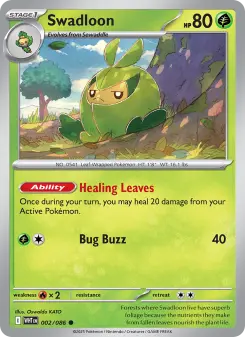 Swadloon40 damage
40 damage becomes 80 against this card
Anorith 2670 HPWhy this card was picked to stand opposite
Of the 1,044 cards in the archive that can remove Anorith 26 in a single attack, this one clears the bar by the smallest margin — 40 printed damage against a bar of 35. Anything printed higher removes it just as surely, so this is where the line actually sits, and this print is legal in Standard play today.
Read from the weakness printed in the lower-left corner of the card.
| Card | Set | HP | Printed damage | After weakness |
|---|---|---|---|---|
| Flapple VMAX (19) | Battle Styles | 320 | 250 | 500 |
| Flapple VMAX (164) | Battle Styles | 320 | 250 | 500 |
| Mega Venusaur ex (3) | Mega Evolution | 380 | 240 | 480 |
| Mega Venusaur ex (155) | Mega Evolution | 380 | 240 | 480 |
| Mega Venusaur ex (177) | Mega Evolution | 380 | 240 | 480 |
| Decidueye ex (12) | Perfect Order | 320 | 240 | 480 |
70 HP against a Grass ×2 weakness means any Grass attack printed at 35 damage or more is enough. 1,052 cards in the archive clear that bar.
Back to summaryWhat is Anorith as a Pokémon, across every card it has been printed on?
Anorith 26 is one print of Anorith. The figures below are about the Pokémon rather than this single card — how many times it has been printed, how tough those prints run, and how many of them can still be played.
Every Anorith print on record, split by whether it can still be entered in Standard play.
Legality is read from the print rather than from the Pokémon, so an older copy of the same Pokémon is a different card for tournament purposes.
Back to summaryWhat has to be in play before Anorith 26 can be?
Anorith evolves from Claw Fossil, so the whole line has to be built before this card reaches the field.
- This card cannot be played from your hand onto an empty spot — it goes on top of Claw Fossil.
- It is not the end of the line either — Armaldo evolves from this card, so a deck can keep going past it.
- The line runs 3 stages, so the first card has to be in play 2 turns before this one can be.
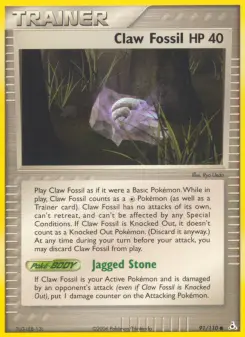
Every print of a stage is counted, not just the one shown in the chain above, so the bar is the ceiling that stage has reached rather than one card from it.
Is this the strongest Anorith print, and can the older ones still be played?
10 prints carry this name in the archive, and 9 of them are laid out below. They share a Pokémon but not a card — printed HP, printed damage and tournament legality all move from one print to the next.
Bar height and the number above each bar = highest HP that year; the two digits below = the year.
| Set | Regulation mark | Standard | |
|---|---|---|---|
| Anorith 111/236 | SM - Cosmic Eclipse | No mark printed | Not legal in Standard |
| Anorith 095/195 | SWSH12: Silver Tempest | Mark F | Legal in Standard |
| Anorith 27/100 | EX Sandstorm | No mark printed | Not legal in Standard |
| Anorith 28/100 | EX Sandstorm | No mark printed | Not legal in Standard |
| Anorith 46/146 | Legends Awakened | No mark printed | Not legal in Standard |
| Anorith 56/114 | XY - Steam Siege | No mark printed | Not legal in Standard |
| Anorith 26/108 | EX Power Keepers | No mark printed | Not legal in Standard |
| Anorith δ 57/110 | EX Holon Phantoms | No mark printed | Not legal in Standard |
| Anorith 29/92 | EX Legend Maker | No mark printed | Not legal in Standard |
1 of the 9 prints listed here are legal in Standard play. An older print of the same Pokémon is a different card for legality, because legality is read from the print rather than from the name — so owning the cheap old copy does not always mean you can enter with it.
Back to summaryWhat can you use instead of Anorith 26?
Every card below asks a deck for the same kind of slot, so the comparison is between what they print, not what they cost.
| Card | Set | HP | Top damage | Retreat |
|---|---|---|---|---|
| Lucario | Pokémon Rumble | 90 | 80 | 1 |
| Rhydon | Skyridge | 90 | 100 | 2 |
| Magcargo | Skyridge | 80 | 40 | 3 |
| Graveler | Legendary Collection | 60 | 40 | 2 |
| Dark Donphan | Neo Destiny | 60 | 50 | 3 |
| Brock's Rhydon | Gym Heroes | 80 | 70 | 3 |
This card itself is 70 HP, 10 top damage and 1 retreat, and every card here is Fighting like it.
Back to summaryWhich other cards share the Pokémon behind Anorith 26?
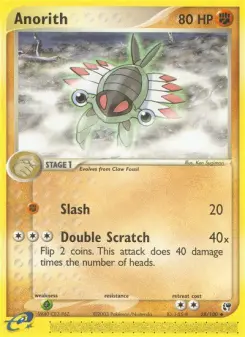
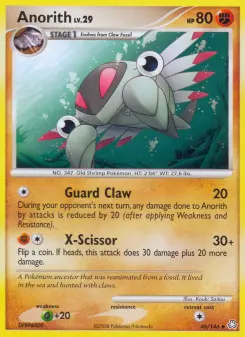
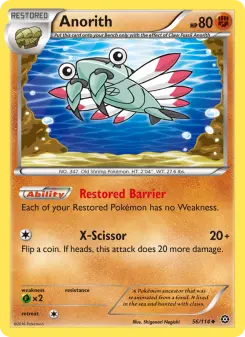
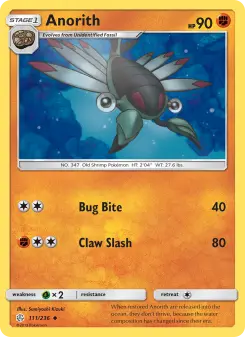
Every card below carries the same Pokédex number as this one, so they are the same Pokémon printed as different cards — different stages, different mechanics and different names all sit in this group.
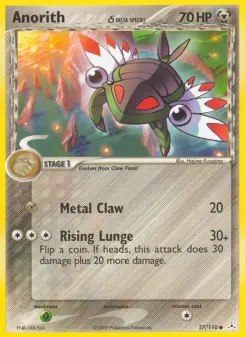 70
Anorith δ [57]
70
Anorith δ [57]
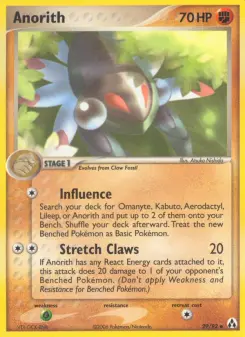 70
Anorith [29]
70
Anorith [29]
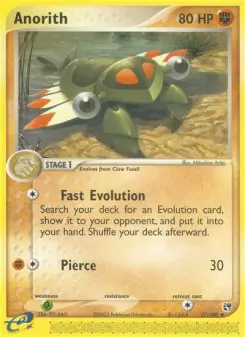 80
Anorith [27]
80
Anorith [27]
 80
Anorith [28]
80
Anorith [28]
 80
Anorith [46]
80
Anorith [46]
 80
Anorith [56]
80
Anorith [56]
 90
Anorith [111]
90
Anorith [111]
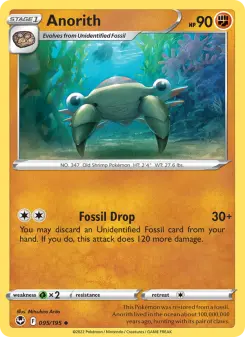 90
Anorith [95]
90
Anorith [95]
8 cards in the archive share this Pokédex number. The badge on each card is its printed HP, the figure under the name is its hardest printed attack, and the name sits under the picture. Point at a card to see it full size.Tap a card to open its page.
What was printed next to Anorith 26 in Power Keepers?
A card is met inside a set, not on its own, and the number on it is the order that set gave it. The cards either side are the ones a collector actually turns past to reach this one.
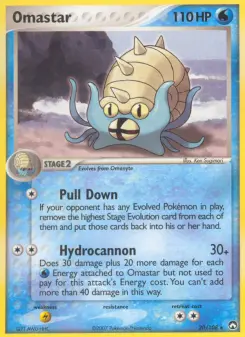 110
Omastar [20]
110
Omastar [20]
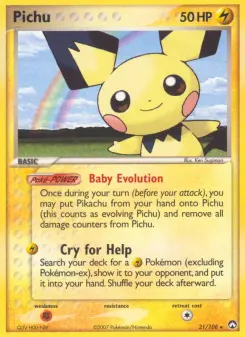 50
Pichu [21]
50
Pichu [21]
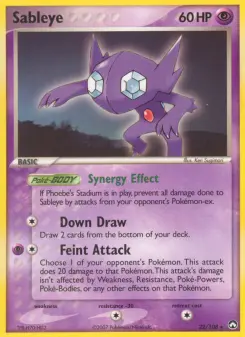 60
Sableye [22]
60
Sableye [22]
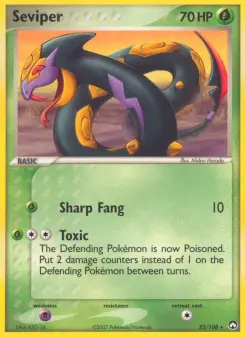 70
Seviper [23]
70
Seviper [23]
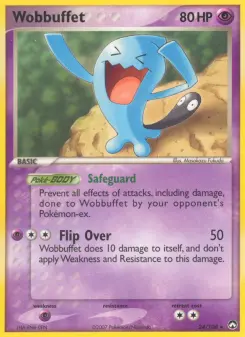 80
Wobbuffet [24]
80
Wobbuffet [24]
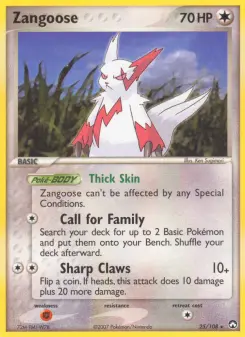 70
Zangoose [25]
70
Zangoose [25]
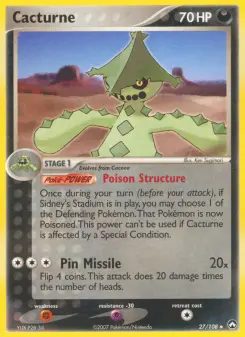 70
Cacturne [27]
70
Cacturne [27]
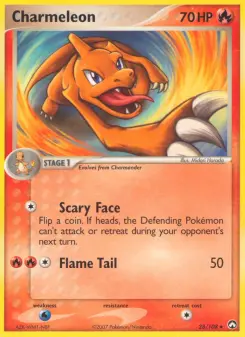 70
Charmeleon [28]
70
Charmeleon [28]
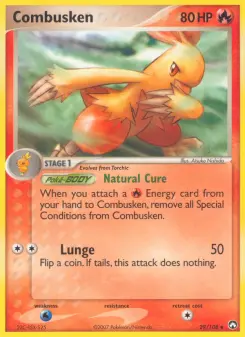 80
Combusken [29]
80
Combusken [29]
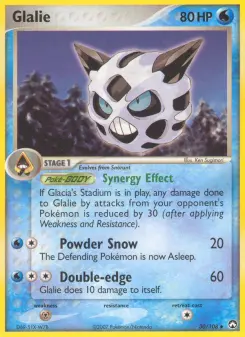 80
Glalie [30]
80
Glalie [30]
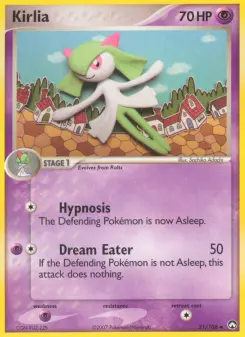 70
Kirlia [31]
70
Kirlia [31]
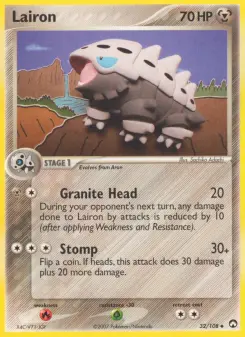 70
Lairon [32]
70
Lairon [32]
These are the cards numbered either side of #26 in Power Keepers. The badge on each card is its printed HP. Point at a card to see it full size.Tap a card to open its page.
Which rules apply to Anorith 26, and where can it be played?
Two kinds of rule meet on one card — the sentence printed on the card face, and the rulebook clauses that apply because of what the card carries.
| Clause | What the rulebook says | Cards it applies to | Share of the archive |
|---|---|---|---|
| Weakness | Some Pokemon have Weakness or Resistance to Pokemon of certain types, marked in the lower-left corner of the card. | 16,744 cards | 81.9% |
| Retreat | Retreat your Active Pokemon (only once per turn). | 17,244 cards | 84.3% |
| Energy per turn | You can attach Energy just once each turn! | 17,180 cards | 84.0% |
Counted across 20,444 English cards. A clause applies to this card because the card carries the property the clause names, not because we judged it to.
| Format | Status | What that means |
|---|---|---|
| Standard | Not listed | This card is not listed for this format |
| Expanded | Not listed | This card is not listed for this format |
| Unlimited | Legal | Can be played in this format |
Read from the format list recorded with the card. Formats rotate on a schedule set by the organiser, and that schedule is not published on this page.
Where this card can be played
This card is legal in Unlimited play. It was released on February 2, 2007.
Anorith 26 in depth — what these figures add up to
Three readings of the same card, side by side: what it costs to get going, where it sits among the cards it will be compared with, and what takes it off the field.
What it asks a deck for
- Its hardest attack, Fury Cutter, needs 2 Energy attached. Energy attaches once a turn, so that attack waits 2 turns from an empty card.
- That works out at 5 damage for every Energy card attached.
- Moving it out of the active spot costs 1 more Energy, discarded from the card itself.
- It cannot start the game in play — Claw Fossil has to be on the field first.
Where its HP stands, cut four ways
What actually removes it
- A Grass attack printed at 35 damage removes it in a single turn — that is the bar, not its 70 HP.
- 1,052 cards in the archive clear that bar.
Anorith 26 card record
| Hit points | 70 HP | Type | Fighting |
|---|---|---|---|
| Weakness | Grass ×2 | Retreat cost | 1 Energy |
| Evolves from | Claw Fossil | Card type | Stage 1 |
| Pokédex number | #347 | Set | Power Keepers |
| Card number | 26 of 108 | Series | EX |
| Released | February 2, 2007 | Rarity | Uncommon |
| Illustrator | Midori Harada | ||
| Tournament legality | Unlimited only | ||
Read from the printed card face, the set listing and the official format list.
What does Anorith 26 cost?
This page is about what the card does. The figure below is the one number worth carrying across, read on August 14, 2026.
Anorith 26 — frequently asked questions
How much damage does it take to knock out Anorith 26?
What is the strongest attack on Anorith 26?
What is the retreat cost of Anorith 26?
What does the + after the damage on Fury Cutter mean?
Can an older Anorith print be played in a tournament?
What does Anorith evolve from?
Can Anorith 26 be played in a tournament?
Does this page say how good Anorith 26 is in a deck?
Where these card facts come from
Card facts are read once from openly published card files and do not change between readings — a printed card cannot gain HP. The places below are where the same information can be checked. Last updated: July 28, 2026 — the counts and rankings on this page were taken from the card files read on that day.
Primary official source
First-party official sources — the body that issues the data itself, such as a government agency, a statutory register or a rights holder publishing its own records.
Industry source
Second-party sources — marketplaces, trade associations, research institutes and companies that compile data about the market.